
Site Preparation Before Scaffolding Installation
What property owners and project managers need to do before scaffolding arrives on site.
Mana Scaffolding Team
Mana Scaffolding Limited
The scaffolding truck is due at eight in the morning. By seven forty-five, the delivery zone is still blocked by parked cars, the gate is locked, and the homeowner had no idea today was installation day. The crew waits. The clock ticks. The project schedule slides.
This scene plays out on construction sites across Canterbury more often than most project managers would like to admit. The difference between a scaffolding installation that starts on time and one that loses half a day to preventable problems almost always comes down to preparation — the work done before the first tube is lifted off the truck.
Why Preparation Matters
A well-prepared site delivers faster installation, lower costs, a safer working environment, and significantly less frustration for everyone involved. A poorly prepared site does the opposite: delays compound, additional labour is required to work around obstacles, and the relationship between the scaffolding crew and the site manager starts on the wrong foot.
Preparation is not complicated. It is simply the discipline of thinking through what the installation crew will need and ensuring it is ready before they arrive.
Access: The First Non-Negotiable
Scaffolding delivery requires truck access to the delivery point, parking for the installation vehicle, a clear route from the delivery area to the erection site, and no height restrictions such as overhead power lines or low tree branches that could block the vehicle. Turning space for larger trucks is often overlooked until one is trying to reverse out of a narrow driveway.
When access is limited — and on many Christchurch residential sites, it is — the solution is to discuss the situation during quoting. Smaller vehicles may be an option. Manual carrying of materials is possible but adds time and cost. Alternative access points through neighbouring properties or rear lanes can sometimes be arranged.
Beyond vehicle access, the installation team needs working space: a clear area around the erection site for material staging, tool storage, and crew movement. They also need basic facilities — toilet access, a water supply, and shelter for adverse weather.
Ground Conditions: The Foundation of Everything
Scaffolding transfers enormous loads through its base, and the ground beneath must be equal to the task.
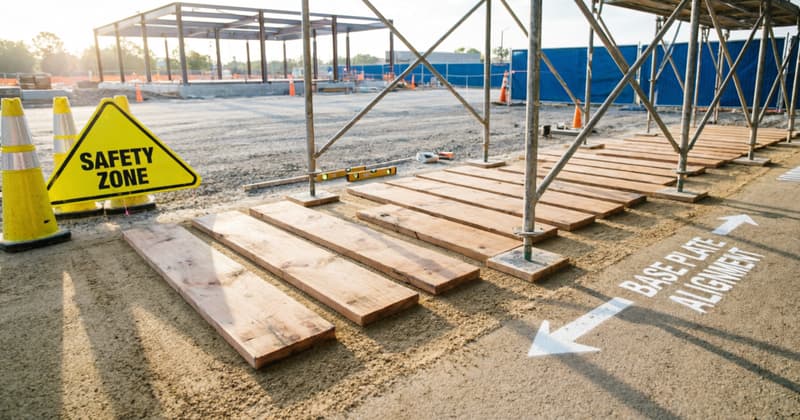
Firm, level ground with good drainage is the ideal. No recent excavation, no saturated soil, no unstable fill. When conditions are less than ideal — and they often are — the solution depends on the specific problem. Soft ground requires base plates and sole boards to spread the load. Uneven surfaces need adjustable base jacks and levelling. Wet areas demand drainage solutions or raised platforms. Contaminated ground requires assessment and protective measures.
The ground assessment that happens during quoting is not a formality. It determines whether your scaffold needs standard base plates or engineered foundations — and that difference can affect both cost and timeline.
Protecting What Matters
Ground preparation also means protecting what is already there. Landscaping — plants, trees, lawns — should be identified during the quoting process so that protection measures can be planned. Driveways and paths may need protection boards. The scaffold’s footprint may need to be adjusted to preserve access routes.
Identifying Underground and Overhead Services
Before any scaffold goes up, underground and overhead services must be located and documented. Power cables, gas lines, water mains, telecommunications, stormwater, and sewer connections — striking any of these during scaffolding installation is dangerous, expensive, and entirely preventable.
Building Preparation: Clearing the Way
The building face where scaffolding will be erected needs to be clear. Debris and materials should be removed. Obstacles along the building perimeter need to go. Vegetation that interferes with the scaffold or access to anchor points should be trimmed. Fixtures on the building face — window boxes, attachments, anything that blocks tie-in points — must be removed before installation day.
Occupant Communication
For tenanted buildings, communication is a critical part of preparation. Occupants need to know the installation dates, expected duration, any access restrictions, what noise to expect, and who to contact with concerns. This is not just courtesy — it prevents the conflicts and complaints that can shut down a site.
Documentation Ready
Having the right paperwork in order before installation day avoids delays. A site plan with services marked, building access arrangements, emergency contact details, and any special requirements should be available for the installation team. Building consent, heritage authority approval, landlord consent, or body corporate approval — whatever applies to your project — should be secured before the scaffold arrives.
The Preparation Failures We See Repeatedly
After years of installations across Canterbury, the same problems recur. Access blocked by parked cars, locked gates, or other building work occupying the delivery zone. Ground issues from unknown underground services, saturated soil, or debris that should have been cleared. Building issues where occupants were not notified, access points are blocked, or tie-in points are inaccessible.
The consequences are always the same: installation delays, additional costs, and frustration on all sides.
Your Preparation Timeline
THE DAY BEFORE
- Double-check that access is clear
- Confirm parking arrangements for the installation vehicle
- Remove movable obstacles from the work zone
- Secure pets if applicable
- Ensure a contact number is available for the crew
INSTALLATION DAY
- Site contact is available and reachable
- Access to all required areas is open
- Facilities are accessible
- The working zone is clear
- Any outstanding questions are addressed with the crew
Mana Scaffolding works with you during the quoting process to identify potential preparation issues, suggest tasks to complete, and plan logistics together. We send reminder communications before installation and remain flexible when last-minute issues arise — because they do, even on well-prepared sites.
Not sure what your site needs before scaffolding arrives? We will walk through it with you during quoting.
Get a QuoteNeed Expert Scaffolding?
Get a free consultation for your next project.
Mana Scaffolding Team
Mana Scaffolding Limited
Based in Christchurch, Mana Scaffolding brings international expertise from Canada and the UK to deliver safe, compliant scaffolding solutions across Canterbury. Contact us at 0508 626 272.
Related Articles
5 Signs Your Construction Site Needs Better Access Solutions
Warning signs that indicate your current access setup is unsafe or inefficient for your construction project.
Scaffolding for Different Trades: Tailoring Access Solutions
How different trades have different scaffolding needs, and how to accommodate them all.
Scaffolding Timeline Planning: From Quote to Removal
Understanding the full lifecycle of scaffolding on your project for better planning and budgeting.