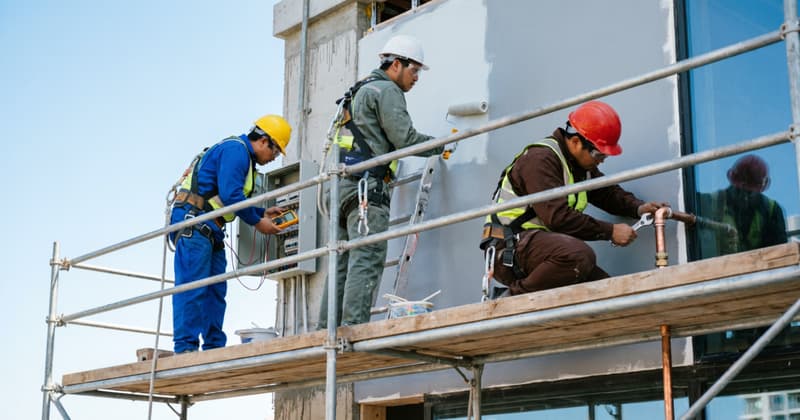

Scaffolding for Different Trades: Tailoring Access Solutions
How different trades have different scaffolding needs, and how to accommodate them all.
Mana Scaffolding Team
Mana Scaffolding Limited
A bricklayer needs a platform strong enough to hold a tonne of bricks at waist height. A painter needs clean, debris-free surfaces close enough to the wall that they can reach every corner. A roofer needs edge access above the gutter line, with a loading bay for materials and a chute for waste. An electrician needs short-duration access at scattered points across the building.
Every trade sees scaffolding differently because every trade works differently. The challenge for project managers and scaffolding providers is designing a system that serves them all — without the cost and disruption of erecting and dismantling separate structures for each phase of work.
Understanding Each Trade’s Access Language
Bricklayers and masons are the heaviest users of scaffolding in terms of load. They need working heights positioned 450–600mm below their work area, platforms boarded out for material storage, structural capacity for full pallets of bricks or blocks, and wide platforms that allow movement without tripping over stacked materials. Get the height wrong and you’ll see bricklayers spending the day bent over or reaching above shoulder height — both recipes for injury and inefficiency.
Painters and decorators have lighter load requirements but more nuanced access needs. They need platforms at various heights to reach different sections of a surface, containment for overspray, and clean working surfaces free of debris that could contaminate the finish. The scaffold is their workspace, and the quality of their work depends directly on how well that workspace is configured.
Roofers need edge access above gutter level, material staging areas, waste removal routes, and often weather protection options for longer projects. The scaffold isn’t just their working platform — it’s their primary safety system, the loading zone for roofing materials, and the collection point for old roofing being removed.
Electricians and plumbers typically need shorter-duration access at multiple points rather than continuous platforms. Their equipment is lighter, but their access requirements are more scattered — they need platforms near specific installation areas, consideration for cable and pipe routing, and flexible timing that accommodates their role in the project sequence.
Window installers have precise requirements: platforms at exact window heights, structural capacity for the weight of glass units, and protection features that prevent damage to both the new windows and the surrounding finished work.
Renderers and plasterers need long continuous platforms that give them uninterrupted access to entire wall surfaces, material preparation areas, and weather protection that prevents fresh render from being compromised by Canterbury’s variable conditions.
The Multi-Trade Coordination Challenge
When multiple trades share scaffolding on a single project, the design challenge escalates significantly. Different height requirements, different access timing, different material storage needs, and potential conflicts between trades working at adjacent levels all need to be resolved before the scaffold is erected.
There are three broad strategies for managing multi-trade scaffolding, each with its own trade-offs.
Phased scaffolding adjusts the structure between trade phases — modifying heights, reconfiguring access points, and adapting to each trade’s specific requirements. This approach is cost-effective when major changes are needed between phases, but it introduces downtime during the transition periods.
Comprehensive design builds a single scaffold with multiple lift heights that serves all trades simultaneously. It’s the most efficient approach in terms of total project time, but it requires higher initial specification and may need longer hire periods.
Trade-specific platforms dedicate sections of the scaffold to individual trades with marked access routes and coordinated scheduling. This works well on larger projects where trades operate in distinct zones.
The heaviest trade on the project determines the minimum load specification for the entire scaffold. Design for the worst case, and every trade works safely.
Design Principles That Serve Everyone
Regardless of which coordination strategy you choose, three principles underpin effective multi-trade scaffolding design.
Flexible access means providing multiple lift heights, various access points, and modification capability. The scaffold should be able to adapt as the project evolves and trade requirements change.
Adequate capacity means the heaviest trade determines the minimum load rating, material storage areas are planned and designated, loading is distributed properly, and safety margins are maintained throughout. Under-specifying to save cost is a false economy when it limits which trades can use the structure.
Convenient access means all work areas are reachable from the scaffold, safe routes exist for every trade, material delivery points are clearly designated, and waste removal access is planned from the outset.
Real-World Configuration Examples
A typical two-storey home renovation might see the ground floor scaffold serving painters and plasterers working on interior-exterior walls, the first floor providing access for window installers and cladding work, the roof level serving roofers and spouting contractors, with electricians and plumbers moving across all levels as needed. A single scaffold, properly designed, serves every trade at every stage.
A commercial facade project follows a similar pattern at larger scale: lower levels for retail fit-out, upper levels for window replacement and facade work, the roof for services and signage installation, with maintenance access required at all levels throughout the project duration.
The Cost Equation
Multi-trade scaffolding delivers genuine economies of scale. One installation covers all trades, shared access reduces per-trade cost, fewer modifications are needed when the design is comprehensive from the start, and equipment is used efficiently across the full hire period.
The trade-offs are higher initial specification, potentially longer hire periods, coordination complexity, and modification costs if project phases change unexpectedly. On the other side of the equation, trade-specific scaffolding for each phase means multiple installation and removal costs, coordination complexity of a different kind, potential conflicts when phases overlap, and often a higher total cost overall.
Our Approach to Multi-Trade Projects
We start with consultation — working alongside project managers and trades to understand every requirement, identify the optimal configuration, plan for phase changes, and document specifications before any equipment arrives on site.
Our flexible design supports multiple lift heights, various access points, modification capability, and trade-specific features where needed. And our coordination support helps manage installation timing, modification scheduling, trade access planning, and safety coordination across the full project lifecycle.
Multi-trade projects demand scaffolding that works for everyone. Let's design access that keeps your entire project moving.
Discuss Your ProjectNeed Expert Scaffolding?
Get a free consultation for your next project.
Mana Scaffolding Team
Mana Scaffolding Limited
Based in Christchurch, Mana Scaffolding brings international expertise from Canada and the UK to deliver safe, compliant scaffolding solutions across Canterbury. Contact us at 0508 626 272.
Related Articles
5 Signs Your Construction Site Needs Better Access Solutions
Warning signs that indicate your current access setup is unsafe or inefficient for your construction project.
Scaffolding for Roof Work: Access Solutions for Every Pitch
Specialized access considerations for different roof types and roofing projects.
Working at Height: Beyond Scaffolding
A comprehensive look at all options for safe work at height, not just scaffolding.