Working at Height: Beyond Scaffolding
A comprehensive look at all options for safe work at height, not just scaffolding.
Mana Scaffolding Team
Mana Scaffolding Limited
The phone call goes something like this: “I need scaffolding for a job.” But what follows is not always a job that needs scaffolding. Sometimes it needs an elevated work platform. Sometimes it needs rope access. Sometimes, with the right tools, it does not need anyone working at height at all.
Scaffolding is one solution among several for working at height, and understanding the full landscape of options — their strengths, their limitations, and where they overlap — leads to better decisions. Sometimes the right answer is scaffolding. Sometimes it is not. Knowing the difference saves money, improves safety, and gets the job done faster.
The Hierarchy of Height Safety
New Zealand’s health and safety framework is built on a hierarchy of control that applies to every work-at-height scenario. It ranks solutions from most effective to least, and every project should work through it from the top.
Eliminate the work at height entirely. Can the task be done from ground level? Prefabrication off-site, tools with extension handles, remote inspection methods, and alternative approaches can sometimes remove the need for anyone to leave the ground. This is always the safest option.
Prevent falls with engineering controls. When work at height cannot be eliminated, provide safe access that prevents falls from occurring. Scaffolding with guardrails, elevated work platforms, permanent platforms, and stair towers all fall into this category — they create an environment where a fall is unlikely, not one where a fall is caught.
Minimise fall distance. If a fall occurs, reduce the consequences. Safety nets, soft landing systems, and fall arrest systems with limited free fall distances limit the damage when prevention fails.
Administrative controls — training, safe work procedures, supervision, and restricted access — add a layer of management around the hazard. They are important but cannot substitute for higher-level controls.
Personal protective equipment — harnesses, lanyards, anchor points, and rescue procedures — is the last resort. It protects the individual but does not remove the hazard.
The hierarchy is not a menu where you pick your favourite option. It is a sequence where you start at the top and work down, using lower-level controls only when higher-level options are genuinely not feasible.
The Access Methods Compared
Scaffolding
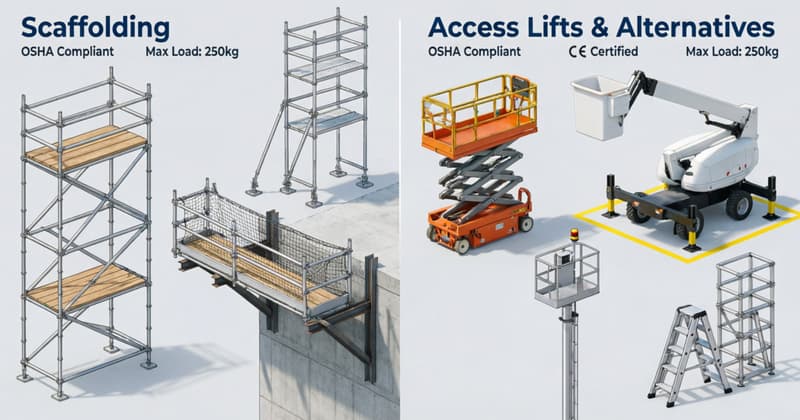
Scaffolding is the workhorse of work-at-height solutions. It provides fall prevention rather than fall arrest — workers operate on platforms with guardrails, not suspended in harnesses. It supports material staging for multiple trades simultaneously. It can be configured with weather protection, debris netting, and custom access features. For extended-duration projects requiring multiple workers and material storage, scaffolding is typically the most cost-effective option.
The trade-offs are installation time, ground footprint, and fixed positioning. Scaffolding takes days to erect, occupies space around the building footprint, and cannot be repositioned without modification.
Elevated Work Platforms
Scissor lifts provide vertical-only access. Boom lifts offer horizontal reach. Both are available in trailer-mounted and self-propelled configurations.
EWPs excel at short-term, point-to-point access: maintenance tasks, inspections, and isolated repair work. They deploy quickly, adjust height on demand, and require no ground modification. The downsides are significant: ground conditions must be firm and level, operator training is required, wind limits are restrictive, and daily hire costs accumulate quickly on extended projects.
Ladders
Extension ladders, step ladders, platform ladders, and roof ladders each serve specific purposes. Ladders are best understood as access tools, not working platforms. They suit very short-duration, light tasks at low risk. Their advantages are minimal cost, instant setup, and portability. Their limitations are substantial: they are not designed as working platforms, fall risk increases dramatically with misuse, capacity is limited, and they are highly sensitive to weather.
Rope Access
Rope access technicians work suspended from rope systems with full fall protection. This method provides access to areas that no other system can reach: confined spaces, difficult facades, structures with no ground footprint available for equipment.
The advantages are compelling — no ground footprint, access to nearly any location, quick setup, and minimal environmental impact. But rope access is highly specialised, limited in the material workers can carry, unsuitable for heavy construction work, weather-sensitive, and requires specific training and certification.
Mast Climbing Work Platforms
These platforms travel vertically on mast systems, providing large work surfaces at adjustable heights. They are purpose-built for tall building facades with straight runs: cladding installation, painting, and facade remediation on multi-storey buildings.
They offer vertical movement, high load capacity, and large platform areas. Their limitation is that they serve straight runs only, require ground preparation and power supply, and need installation time comparable to scaffolding.
Choosing the Right Method
Combined Approaches: The Real-World Solution
Most projects of any complexity use multiple access methods in combination. A building renovation might use scaffolding for the main facade work, an EWP for isolated high points that the scaffold cannot reach, and ladders for quick access to lower areas between scaffold bays.
An industrial maintenance project might scaffold the main plant areas for heavy work, deploy rope access technicians for confined space inspections, and use an EWP for external checks that require mobility around the facility.
The best access solution is rarely a single method. It is a combination selected for the specific demands of each phase, each trade, and each area of the project — integrated so that every worker has the right access at the right time.
Honest Recommendations
A scaffolding company that only recommends scaffolding is not giving you the full picture. Sometimes scaffolding genuinely is not the right answer — and the right provider will tell you that.
At Mana Scaffolding, we start with the question of what your project actually needs, not what we can sell you. If scaffolding is the right answer, we design and build the best scaffold for your job. If another method — or a combination — serves you better, we will say so. Our expertise is in access, and that means knowing when scaffolding is the answer and when it is not.
Not sure which access method suits your project? Let's talk through the options with honest, straightforward advice.
Get a QuoteNeed Expert Scaffolding?
Get a free consultation for your next project.
Mana Scaffolding Team
Mana Scaffolding Limited
Based in Christchurch, Mana Scaffolding brings international expertise from Canada and the UK to deliver safe, compliant scaffolding solutions across Canterbury. Contact us at 0508 626 272.
Related Articles
5 Signs Your Construction Site Needs Better Access Solutions
Warning signs that indicate your current access setup is unsafe or inefficient for your construction project.
Complete Guide to Scaffolding Safety Standards in New Zealand
Everything you need to know about NZ scaffolding safety regulations, AS/NZS 1576 standards, and compliance requirements for construction projects.
Construction Site Safety: The Scaffolding Perspective
How proper scaffolding contributes to overall site safety and WorkSafe compliance.