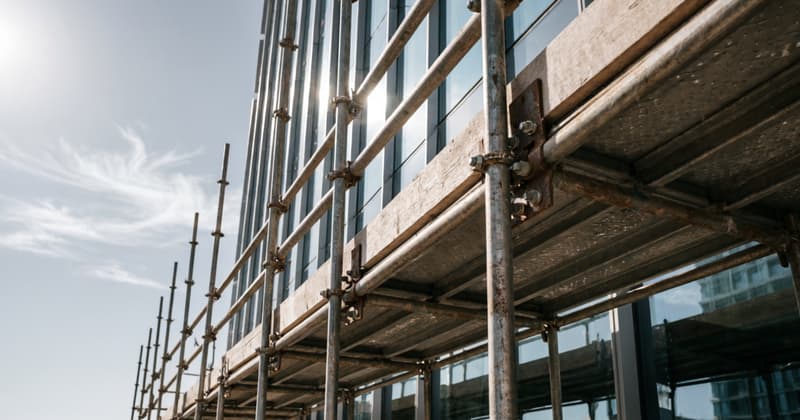

Cantilever Scaffolding: Solutions for Impossible Access
When ground access isn't available, cantilever systems provide safe working platforms.
Mana Scaffolding Team
Mana Scaffolding Limited
Picture a heritage building on a steep Christchurch hillside. The façade needs restoration, but below it lies a slope covered in mature native plantings that cannot be disturbed. Behind it, there’s no room for a standard scaffold base. The only way to reach the work face is from the building itself, extending out over the void. This is the territory where cantilever scaffolding lives — the solution for situations where ground support is impossible, impractical, or prohibited.
When the Ground Disappears
Cantilever scaffolding becomes the right answer in a surprisingly wide range of scenarios. Sometimes the ground literally isn’t there — work over water features, above retaining walls, on sloping sites where the terrain drops away below the work area. Sometimes the ground is present but must be preserved: mature gardens, archaeological sites, heritage paving, or contaminated ground that cannot be loaded or disturbed.
In urban environments, cantilever systems provide upper floor access without street closure, allow work over operating businesses and public spaces, and make possible access to high points where there is simply no room at ground level for foundation supports. Heritage buildings present their own specific case — the philosophy of minimal intervention demands access systems that touch the ground as little as possible and leave no trace when removed.
The Engineering Behind the Extension
Cantilever scaffolding works on a principle that is elegantly simple in concept but demands precision in execution: platforms are extended beyond the last support point, held in place by a combination of counterweights on the building side, structural ties to the building fabric, and carefully balanced load distribution across engineered connection points.
The key components tell the story. Needle beams — horizontal members that project outward from the building — serve as the primary structural elements. These are anchored within the building structure, transferring loads to solid elements capable of carrying them. Every needle beam installation requires professional engineering, because the consequences of getting the load path wrong are severe.
Counterweights balance the cantilevered portion. Their mass is calculated precisely based on the platform load — not just the static weight of workers and materials, but wind loads, potential seismic forces, and dynamic loads from movement on the platform. These weights are securely positioned and continuously monitored throughout the scaffold’s working life.
Tie systems connect the scaffold to the building structure through distributed load points. Where possible, ties are non-invasive — designed to work with the building type without causing damage. In heritage applications especially, the tie design must respect the structural sensitivity of the host building.
Design and Certification
Cantilever scaffolding is never a standard solution. Every installation begins with a structural assessment of the host building — its capacity to carry additional loads, suitable anchor points, load distribution paths, and heritage sensitivity where applicable. Site analysis covers wind exposure, access requirements, work scope, and duration considerations.
The engineering documentation is comprehensive: structural calculations, connection details, load specifications, and inspection requirements. A chartered engineer must provide design certification and a producer statement. The installation methodology must be documented and approved before any work begins.
Built in Stages
Installation follows a precise sequence that leaves nothing to chance. Anchor points are prepared first — secured attachment points with engineering verification and surface protection applied. Needle beams are positioned and secured, then load-tested and safety-verified. The cantilever extension follows — careful positioning with counterweight installation and level adjustment. Finally, the platform itself is installed: decking, guardrails, access provision, and the tag system activated.
At every stage, there are checkpoints. Cantilever scaffolding does not tolerate shortcuts.
Safety: The Non-Negotiables
Enhanced safety protocols apply throughout the life of a cantilever scaffold. Pre-work requirements include engineering certification, load testing, anchor point verification, and complete documentation. During use, regular inspections continue, counterweights are monitored, load limits are enforced, and weather conditions are watched closely.
Canterbury Applications and Seismic Demands
Cantilever systems are particularly relevant in Canterbury, where the combination of heritage buildings, hillside properties, and urban constraints creates frequent demand for access without ground support. The region’s heritage stock requires protection of significant surfaces and minimal intervention. Hillside properties along the Port Hills and surrounding slopes present natural terrain challenges. And busy central city streets often can’t be closed for standard scaffold foundations.
But Canterbury also adds a seismic dimension. Cantilever systems in this region require enhanced lateral capacity, seismic load calculations, movement accommodation, and emergency procedures. The same ground that makes standard scaffolding more complex in Canterbury makes cantilever work even more demanding.
Is Cantilever Right for Your Project?
Cantilever scaffolding is a specialised solution, and it’s not always the first answer. Before choosing cantilever, it’s worth considering alternatives: suspended scaffolding if overhead anchors exist, elevated platforms if access allows, roof-based systems if the roof is available, or mobile elevating work platforms if the ground permits.
Our Cantilever Experience
Mana Scaffolding has designed and installed cantilever systems across Canterbury for heritage building restorations, hillside residential projects, commercial façade work over operating retail spaces, and archaeological sites requiring ground protection. Our process is consistent: comprehensive site assessment, professional engineering design, installation by an experienced team with specialised training, and ongoing inspection and modification support with full compliance documentation throughout.
Facing an access challenge that seems impossible? Cantilever scaffolding might be the answer. Talk to our engineering team.
Discuss Your ProjectNeed Expert Scaffolding?
Get a free consultation for your next project.
Mana Scaffolding Team
Mana Scaffolding Limited
Based in Christchurch, Mana Scaffolding brings international expertise from Canada and the UK to deliver safe, compliant scaffolding solutions across Canterbury. Contact us at 0508 626 272.
Related Articles
Seismic Scaffolding: Designing for Christchurch Conditions
Scaffolding in earthquake-prone Christchurch requires specialized design considerations. Learn how we ensure stability and safety during seismic events.
Choosing the Right Scaffolding System for Your Project
A guide to different scaffolding systems and when each is appropriate for Canterbury construction projects.
Scaffolding for Roof Work: Access Solutions for Every Pitch
Specialized access considerations for different roof types and roofing projects.