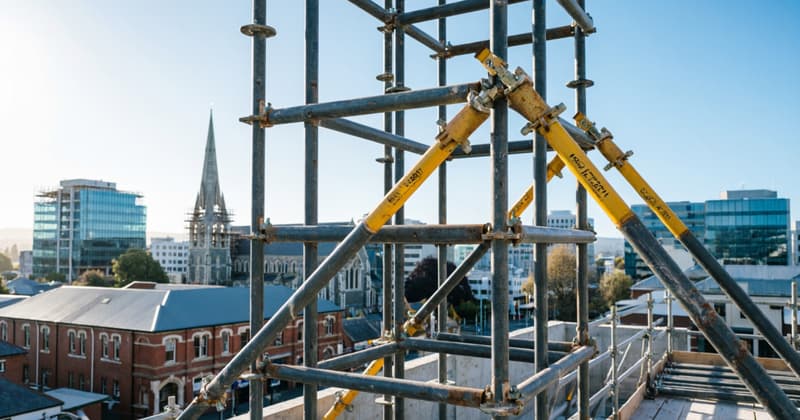

Seismic Scaffolding: Designing for Christchurch Conditions
Scaffolding in earthquake-prone Christchurch requires specialized design considerations. Learn how we ensure stability and safety during seismic events.
Terry Pohatu
Mana Scaffolding Limited
In February 2011, scaffolding across Christchurch swayed, buckled, and in some cases collapsed as the ground beneath it moved with a violence no engineer had fully anticipated. The lessons from that day — and from the thousands of aftershocks that followed — permanently changed how scaffolding is designed and installed in Canterbury. If you are erecting scaffolding in this region without accounting for seismic forces, you are not building to the conditions the site will actually face.
The Canterbury Seismic Context
Christchurch sits in a high seismic risk zone. That is not a historical footnote — it is a present-day engineering reality. Aftershocks can occur months or even years after a major event. Liquefaction risk persists in areas with vulnerable soils. Buildings that have been repaired or strengthened may still harbour hidden weaknesses, and heritage structures carry their own set of fragilities that demand special treatment.
The post-earthquake building environment in Canterbury is unique in New Zealand. New builds incorporate higher seismic standards than older structures. Many existing buildings have unknown vulnerabilities that only become apparent under stress. And heritage buildings — of which Christchurch has many still awaiting restoration — require an approach that balances access needs with structural sensitivity.
Scaffolding in Christchurch is not the same as scaffolding in Auckland or Wellington. The ground has a history here, and that history must be designed into every installation.
Design Principles for Seismic Conditions
Scaffolding in seismic zones must be engineered to resist horizontal forces that standard installations never face. This begins with lateral load resistance — the capacity of the scaffold to absorb ground movement without toppling. In practice, this means diagonal bracing at closer intervals than typical installations, additional ties to the building structure where possible, wider base widths for increased stability, and flexible connections that can accommodate some movement without failure.
Foundation design takes on outsized importance. Enhanced base plates and sole boards spread loads more effectively. Ground assessment for liquefaction potential is essential on many Canterbury sites. Adjustable bases compensate for settlement that may occur over the scaffold’s working life. And on critical installations, monitoring systems track stability in real time.
The connections themselves are engineered differently. Couplers that allow some rotation without failure, redundant load paths so that a single connection failure doesn’t cascade, and energy-absorbing connections for larger events — these are the details that separate a seismic-ready scaffold from one that will become a hazard when the ground moves.
Putting It Into Practice
On every Christchurch installation, the process begins with a detailed site assessment that includes geological data. For structures above certain heights, an independent engineering review is mandatory. Tie-in points to the building structure are enhanced, and the standard inspection intervals — already rigorous — are shortened to account for the additional risk.
The operational protocols are equally clear. Every scaffold crew in Canterbury should have documented procedures for safe evacuation following a seismic event, and emergency contact protocols for significant events must be established before work begins.
A Heritage Building That Proved the Approach
A recent project involved scaffolding a three-storey heritage building in Christchurch for a full façade restoration. The seismic design approach we took was comprehensive: base width increased from the standard 1.8 metres to 2.4 metres, diagonal bracing placed at 3-metre intervals instead of the typical 4 to 6 metres, 40 percent more ties than a standard installation, flexible ledger connections, and GPS monitoring for settlement.
During the project, a 4.2 magnitude aftershock struck. The scaffolding moved with the building — exactly as designed — and remained stable throughout. The post-event inspection found no damage, no movement, and no compromise to any connection. The system performed as intended because it was engineered for the reality of its environment.
The Regulatory Landscape
The regulatory framework for scaffolding in seismic zones draws from several sources. AS/NZS 1576 incorporates seismic considerations at the national level. The Building Act requires structural adequacy for temporary works. And MBIE guidelines provide specific direction for post-earthquake construction activity.
At the local level, Christchurch City Council may require specific engineering sign-off for taller scaffolds, site-specific seismic design loads, and additional documentation for heritage projects. These requirements vary by location and building type, which is why local knowledge is essential.
International Experience, Local Application
Our approach at Mana Scaffolding draws on experience from Canadian seismic zones — particularly British Columbia — as well as practice from the United Kingdom. These international perspectives, combined with deep local knowledge of Canterbury conditions, inform every seismic scaffolding design we produce.
We maintain relationships with structural engineers who specialise in seismic design, and our quality systems ensure rigorous inspection and documentation throughout every project. Multiple post-earthquake projects across Canterbury have tested and validated our methods in real conditions.
Scaffolding in a seismic zone demands more than standard practice. Talk to our team about engineered solutions for your Canterbury project.
Get a QuoteNeed Expert Scaffolding?
Get a free consultation for your next project.
Terry Pohatu
Mana Scaffolding Limited
Based in Christchurch, Mana Scaffolding brings international expertise from Canada and the UK to deliver safe, compliant scaffolding solutions across Canterbury. Contact us at 0508 626 272.
Related Articles
Scaffolding for Earthquake-Prone Buildings in Christchurch
How modern scaffolding techniques protect workers and structures in Canterbury's seismic zones.
Cantilever Scaffolding: Solutions for Impossible Access
When ground access isn't available, cantilever systems provide safe working platforms.
Commercial Façade Restoration: A Scaffolding Case Study
How proper scaffolding enabled complete heritage façade restoration in Christchurch CBD.