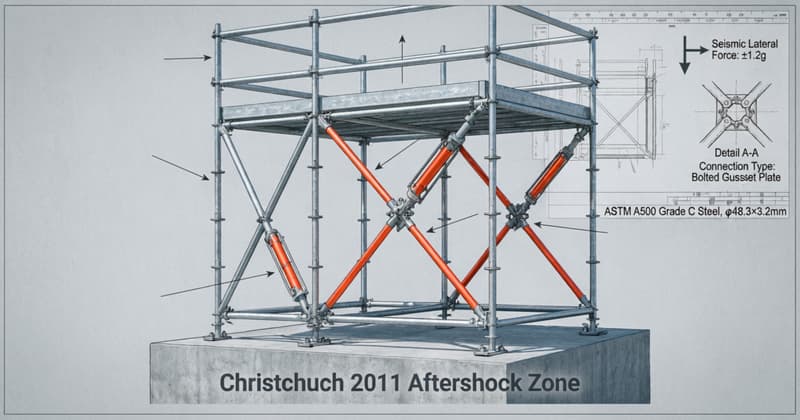

Scaffolding for Earthquake-Prone Buildings in Christchurch
How modern scaffolding techniques protect workers and structures in Canterbury's seismic zones.
Mana Scaffolding Team
Mana Scaffolding Limited
Christchurch lives with the ground beneath it. The 2011 earthquakes reshaped not only the city’s landscape but its entire approach to construction — and scaffolding, the temporary framework that supports every repair, rebuild, and restoration, had to evolve alongside it. In a seismic zone, scaffolding is not simply a platform for workers. It is a structure that must withstand lateral forces from aftershocks, remain stable on ground that may liquefy, and provide evacuation routes when the earth moves without warning.
This is scaffolding engineered for a city that knows what shaking feels like — and it requires a fundamentally different approach from standard installations.
The Canterbury Seismic Context
Since 2011, Christchurch has implemented some of the strictest building codes in the Southern Hemisphere. Construction practices have been rewritten, and scaffolding — the infrastructure that enables all of this rebuilding — has had to keep pace.
Every scaffold erected in Canterbury must account for aftershock potential that generates lateral forces no standard installation is designed to handle. It must be founded on variable ground conditions where liquefaction-prone soils can behave unpredictably during seismic events. It must accommodate structural movement in buildings under repair that may shift as work progresses. And it must provide emergency egress — rapid evacuation routes that workers can reach and use in seconds.
These are not theoretical concerns. Magnitude 4 and 5 aftershocks continue to rattle the region, and any scaffold on site when one arrives must perform.
Engineering Scaffolding for Seismic Forces
Modern seismic scaffolding relies on four critical design features that differentiate it from standard installations.
Diagonal Bracing Systems
Additional diagonal bracing provides the lateral stability that standard scaffolding lacks. Cross-bracing patterns distribute seismic forces throughout the entire structure rather than concentrating them at single points. This network of bracing means that when the ground shifts, the scaffold flexes and distributes the load rather than folding at its weakest point.
Reinforced Foundation Plates
Heavy-duty base plates with larger surface areas prevent the scaffold from sinking during ground movement — a critical consideration in Christchurch’s liquefaction-prone soils. For taller structures, steel plates up to 600mm square are used to spread the load across a wider footprint and maintain stability when the ground beneath softens.
Flexible Couplings
Modern couplers are designed to allow slight movement without compromising structural integrity. This flexibility is the key insight of seismic scaffolding engineering: rather than resisting seismic energy rigidly, the scaffold absorbs it through controlled movement at connection points. The structure dances with the earthquake rather than fighting it.
Independent Access Towers
Free-standing access towers are engineered to remain stable even if the building they serve moves during a seismic event. This independence means that when an aftershock hits, workers have evacuation routes that do not depend on the building’s structural integrity — they can get down regardless of what the building does.
In seismic zones, the scaffold’s relationship to the building must be carefully managed. Tie-ins provide stability in normal conditions, but independent structural capacity ensures safety when the building itself becomes the hazard.
Best Practices: Before, During, and After
Pre-Installation Assessment
Before any scaffold goes up in a Canterbury seismic zone, four assessments are essential:
- A geotechnical review of ground conditions to identify liquefaction risk
- A structural engineer consultation for any building under repair
- A review of historical seismic data for the specific area
- A documented emergency evacuation plan that every worker on site understands
During Construction
Once the scaffold is in service, regular inspections after any seismic activity above magnitude 3.0 are mandatory. Any movement or settling must be documented. Workers need training in seismic emergency response, and safe zones and evacuation routes must be clearly marked on every level.
A Proven Track Record
During the restoration of a heritage building in central Christchurch, Mana Scaffolding installed 40 metres of independent scaffolding with full seismic bracing. The project included rapid-deployment evacuation slides, ground sensors to detect foundation movement, and real-time monitoring during aftershocks.
Over the six-month installation period, the site experienced several magnitude 4+ aftershocks. The project completed without incident — not because the ground was kind, but because the engineering was right.
Compliance: Non-Negotiable Standards
All seismic scaffolding installations in Canterbury must comply with AS/NZS 1170.2 for structural design actions, NZS 3404 for loadings, MBIE guidance on seismic design, and Christchurch City Council requirements. These are not aspirational benchmarks — they are minimum standards, and they exist because experience has shown what happens when they are not met.
International Expertise, Local Application
Mana Scaffolding’s team brings experience from British Columbia, Canada — a region with seismic engineering requirements comparable to Canterbury’s. Those international protocols have been adapted for New Zealand conditions, combining proven seismic engineering principles with local knowledge of Canterbury’s ground conditions, building stock, and regulatory environment.
This means structural engineers on staff for complex projects, specialised seismic bracing components, emergency protocols that have been tested and documented, and workers trained in seismic response — not just scaffold erection.
Working on an earthquake-prone building in Canterbury? Get a technical assessment and specialised seismic scaffolding design from engineers who understand the ground you're building on.
Get a Seismic AssessmentNeed Expert Scaffolding?
Get a free consultation for your next project.
Mana Scaffolding Team
Mana Scaffolding Limited
Based in Christchurch, Mana Scaffolding brings international expertise from Canada and the UK to deliver safe, compliant scaffolding solutions across Canterbury. Contact us at 0508 626 272.
Related Articles
Seismic Scaffolding: Designing for Christchurch Conditions
Scaffolding in earthquake-prone Christchurch requires specialized design considerations. Learn how we ensure stability and safety during seismic events.
Complete Guide to Scaffolding Safety Standards in New Zealand
Everything you need to know about NZ scaffolding safety regulations, AS/NZS 1576 standards, and compliance requirements for construction projects.
5 Signs Your Construction Site Needs Better Access Solutions
Warning signs that indicate your current access setup is unsafe or inefficient for your construction project.