
Scaffolding Insurance: What's Covered and What's Not
Understanding insurance coverage for scaffolding protects both property owners and contractors.
Mana Scaffolding Team
Mana Scaffolding Limited
A scaffold collapses on a commercial site and injures a passerby. A tradesman drops a tool from a residential scaffold and damages a parked car. A storm damages scaffolding that’s been erected on your property for three weeks. In each of these scenarios, the question of who pays — and whose insurance responds — depends on coverage that should have been confirmed before the scaffold went up, not after something went wrong.
Insurance is the least glamorous aspect of any scaffolding project, and it’s the one most people skip past in the contract. But when something goes wrong on a scaffolding project, the difference between adequate coverage and a coverage gap can be the difference between a managed incident and a financial catastrophe.
The Three Insurance Layers
Every scaffolding project involves at least three parties, each with their own insurance responsibilities: the scaffolding provider, the property owner, and the contractor performing the work. Understanding who carries what coverage — and where the gaps between them fall — is essential.
The Scaffolding Provider’s Coverage
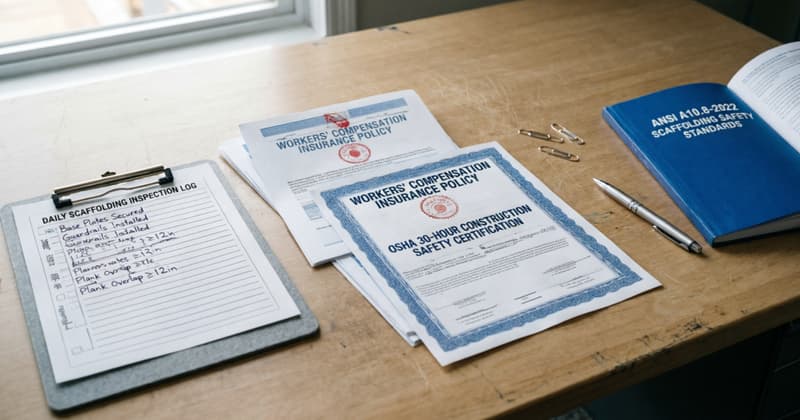
A professional scaffolding company should carry four types of insurance as a minimum. Public liability insurance covers third-party injury and property damage to others, with coverage typically ranging from $1 million to $5 million. This is the foundational policy that protects against the most common and costly scaffold-related claims.
Professional indemnity insurance covers design errors and omissions — critical when the scaffolding provider is supplying engineering advice or designing complex structures. Not every provider carries this, and it’s worth asking specifically.
Workers’ compensation through ACC covers employee injuries and is mandatory for all New Zealand employers. And equipment insurance covers the provider’s owned equipment against theft and damage — though the terms may not extend to equipment while it’s on hire at your site.
The Property Owner’s Position
Property owners aren’t passive bystanders in the insurance equation. Your own public liability policy may cover scaffold-related incidents on your property, but it’s essential to check with your insurer rather than assume. Property insurance covers the building itself but may exclude construction work — which means you need to notify your insurer before any major work begins and check exclusion clauses carefully.
Contract works insurance covers the project during construction and is often separate from your standard property policy. It’s frequently required by contract and strongly recommended for any major project. Skipping it to save premium is a decision that only looks smart until something goes wrong.
The Contractor’s Responsibilities
Any contractor working from the scaffold should carry their own public liability insurance with a minimum of $1 million coverage. Contract works insurance covering materials and work in progress may also be required, depending on the contract terms. Verifying current coverage before work begins isn’t bureaucratic — it’s prudent.
Where Coverage Gaps Hide
The most dangerous insurance situations arise not from missing policies but from gaps between them — areas where everyone assumes someone else is covered.
Property insurance policies commonly exclude construction work, may not cover scaffold damage, and often contain exclusion clauses that specifically carve out building projects. The standard advice to notify your insurer before major work isn’t a courtesy — it’s a condition of maintaining coverage.
Public liability policies may carry height restrictions that kick in above certain levels, commonly exclude construction work unless specifically endorsed, may require notification before scaffold-related activities begin, and might have limits that are inadequate for the actual risk exposure.
Contract works policies can include duration limits, value restrictions, specific exclusions for certain types of work, and may not cover damage to existing structures — only new work.
Contract Clauses That Protect Everyone
The scaffolding hire contract is where insurance expectations become enforceable obligations. At minimum, your contract should specify minimum coverage amounts, require certificates of currency before work begins, name interested parties where appropriate, require notification of any coverage changes during the project, and include evidence requirements that ensure you’re not taking someone’s word for it.
Typical requirements include public liability of $1–5 million, professional indemnity of $1 million where design services are involved, evidence provided before work starts, and confirmation that coverage is maintained throughout the project.
Indemnity clauses — where each party takes responsibility for their own negligence — provide clear liability allocation that’s reasonable and enforceable. Hold harmless clauses, where one party agrees to indemnify another, can be one-way or mutual and should always be reviewed for enforceability in the New Zealand legal context.
The Pre-Hire Insurance Checklist
Before engaging any scaffolding provider, seven questions will tell you most of what you need to know about their insurance position:
The documentation you should obtain includes certificates of currency for public liability, professional indemnity certificates where applicable, workers’ compensation evidence, insurance company details, and policy numbers with expiry dates. This isn’t paperwork for paperwork’s sake — it’s the evidence trail that protects everyone involved.
Our Insurance Commitment
At Mana Scaffolding, we carry a minimum of $2 million public liability coverage for all scaffolding operations, $1 million professional indemnity covering engineering advice and design services, and full ACC coverage for all employees. Current certificates of currency are available on request, policies are updated annually, and we can provide specific project documentation and additional insured arrangements where required.
Insurance isn’t exciting. But it’s the foundation that allows every other aspect of your project to proceed with confidence. If you have questions about coverage for an upcoming scaffolding project, we’re happy to walk through the specifics.
Don't discover a coverage gap after something goes wrong. Let's confirm your protection before the scaffold goes up.
Verify Your CoverageNeed Expert Scaffolding?
Get a free consultation for your next project.
Mana Scaffolding Team
Mana Scaffolding Limited
Based in Christchurch, Mana Scaffolding brings international expertise from Canada and the UK to deliver safe, compliant scaffolding solutions across Canterbury. Contact us at 0508 626 272.